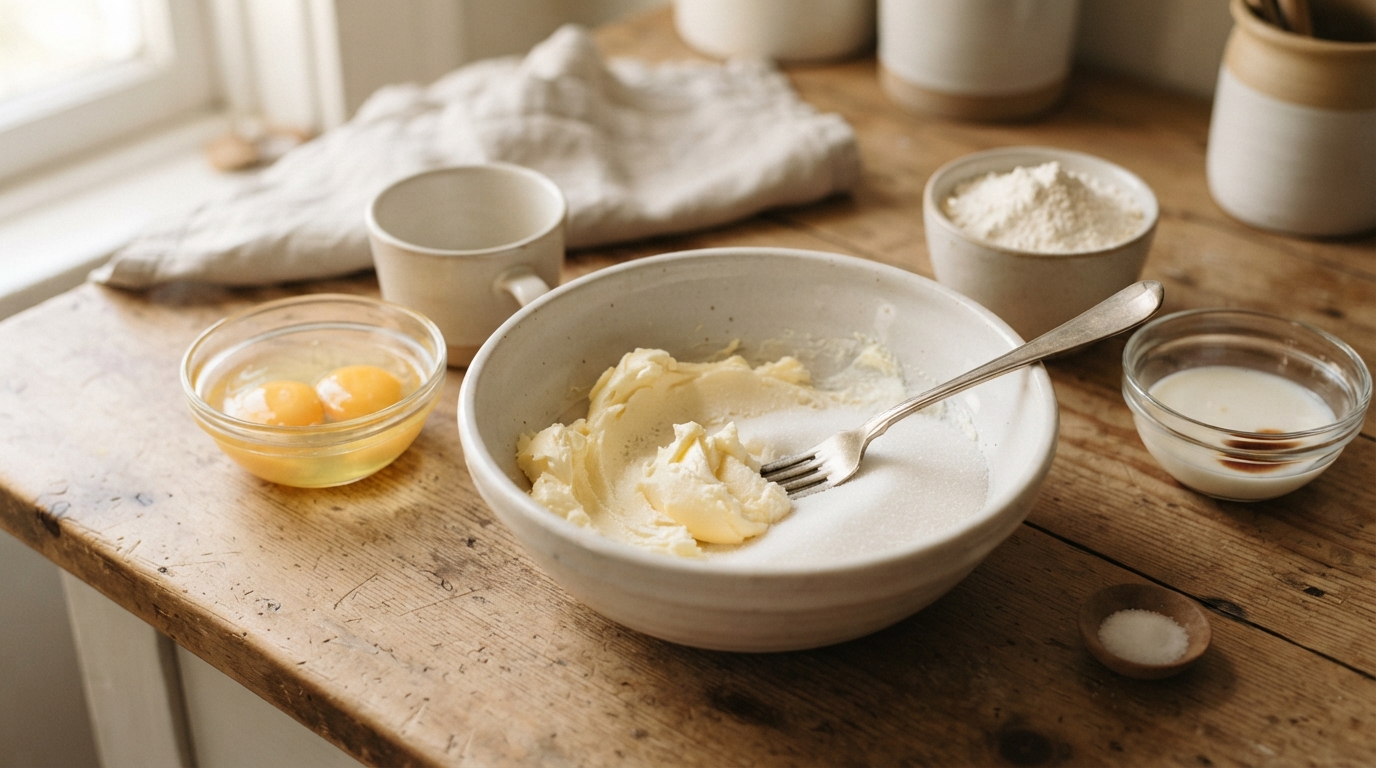
Room Temperature Baking Ingredients in Five Minutes
Recipe IdeasThe Chemistry of Temperature
Baking relies on emulsions and structural networks that depend entirely on temperature. When a recipe calls for room-temperature ingredients, it is not offering an aesthetic suggestion. It is defining a precise chemical window. Most baking emulsions—specifically the combination of fat, water, and sugar—perform correctly only when ingredients sit between 65°F and 70°F.
At this range, butter is a plastic solid. It contains microscopic fat crystals trapped around tiny droplets of water. When creamed with sugar, those crystals hold their shape long enough to carve millions of tiny air pockets into the mixture. These air pockets expand in the oven, providing lift. If the butter is too cold, the crystalline structure is too rigid. The sugar grinds against it without creating air pockets, leaving the mixture dense and lumpy. If the butter melts, the crystal structure collapses. Liquid fat cannot hold air bubbles, resulting in flat, greasy cakes and heavy cookies.
Temperature consistency across ingredients is equally critical. Adding cold eggs or milk to warm butter shocks the fat. The butter solidifies instantly into small, grainy specks, breaking the emulsion. Warm liquid and warm fat bond smoothly; temperature disparity causes them to separate.
Softening Butter Safely
The challenge with butter is that its functional range is narrow. It melts at roughly 90°F, but it loses its ability to cream effectively several degrees lower. Bringing a block of butter from fridge temperature to 65°F requires patience or precise mechanical intervention.
The most reliable rapid method relies on mechanical surface area rather than high heat: the box grater. Scraping a cold stick of butter against the large holes of a cheese grater transforms a thick, dense block into hundreds of thin, curling ribbons. This increases the surface area exposed to ambient room air by a factor of twenty. Within two to three minutes, the ribbons soften evenly to room temperature without any risk of liquid melting.
A second mechanical option is pounding. Place the cold stick of butter between two sheets of parchment paper and strike it firmly with a heavy rolling pin. Flattening the butter breaks its rigid structure through friction and mechanical movement rather than thermal heat. Flip the flattened sheet, fold it over itself, and pound it flat once more. Within sixty seconds, the butter becomes pliable while remaining cool to the touch.
If using a microwave, extreme caution is necessary. Set the microwave to 10 percent or 20 percent power. High power heats water molecules unevenly, creating pockets of hot water inside the butter that melt the surrounding fat before the exterior feels warm. Heat the stick in 5-second to 10-second intervals, rotating the stick a quarter-turn after each burst.
Visual and tactile cues determine whether the butter is ready. Properly softened butter yields under gentle pressure from a thumb, leaving a clean indent without sinking through or sliding across a greasy surface. If the butter appears shiny, yellow-transparent, or liquid at the corners, the fat structure has broken. Melted butter cannot be repaired by returning it to the refrigerator; cooling re-solidifies the fat, but it destroys the delicate water-in-fat emulsion required for creaming.
Warming Eggs in Minutes
Eggs straight from the refrigerator sit at roughly 38°F. Dropping two or three cold eggs into a creamed butter and sugar mixture lowers the temperature of the entire bowl, causing the butter to curdle instantly.
Warming eggs quickly requires a warm water bath. Place whole, uncracked eggs into a small bowl. Fill the bowl with warm tap water. The water should feel comfortably warm to the touch, roughly 100°F to 110°F. Do not use hot or boiling water; temperatures above 140°F begin to denature the proteins in the egg white, cooking a thin layer of albumen against the inner surface of the shell.
Submerge the eggs completely and leave them undisturbed for three to five minutes. The water transfers heat into the egg far faster than air can. To test if the egg is ready, remove it from the water and hold it in the palm of your hand. It should feel neutral—neither cold nor distinctly hot—matching natural body temperature.
Always dry the eggshell thoroughly with a towel before cracking. Water entering a batter alters the liquid ratio and can destroy delicate foams, such as whipped egg whites or meringues, by introducing surface tension that prevents air retention.
Managing Cream Cheese and Liquid Dairy
Liquid dairy ingredients like milk, buttermilk, heavy cream, and sour cream, along with cultured solids like cream cheese, require specific handling to prevent curdling or separation.
For liquid dairy, gentle microwave heating is the fastest route. Pour the required volume of milk or cream into a microwave-safe measuring glass. Heat at 30 percent to 50 percent power in 10-second increments, stirring between each interval to distribute the heat evenly. Liquid heated from the bottom can scorch or curdle at the base while remaining cold at the surface. Stirring ensures an even temperature profile. The goal is liquid that feels neutral when a drop is tested on the inner wrist.
Cream cheese presents a unique problem due to its dense, high-fat, high-moisture matrix. When cold, it remains stiff and resists blending, creating small white lumps in batters and frostings. To warm cream cheese rapidly, cut the block into half-inch cubes. Spreading these cubes across a plate exposes maximum surface area to the air. At room temperature, small cubes soften in under ten minutes.
To shorten that time to under two minutes, place the cubed cream cheese on a microwave-safe plate and heat at 10 percent to 20 percent power in 10-second bursts. Watch the edges closely. The cheese should feel soft and yield when pressed with the back of a spoon. If oil begins to bead on the surface or collect around the base, the emulsion has separated, which will cause frosting or cheesecake batter to turn oily and loose.
Alternatively, leave the cream cheese sealed in its original foil wrapper and submerge the packet in a bowl of warm tap water for five minutes. The metal foil conducts heat efficiently into the dense block without exposing the cheese to direct moisture.
Open Crave It!