Techniques for High-Flavor Vegetable Ragù
Recipe IdeasThe Mechanics of a Classic Ragù
Traditional meat ragùs derive their depth from two distinct sources: the gradual extraction of gelatin from connective tissue and the slow browning of protein and fat. As meat simmers, collagen breaks down into gelatin. This gelatin acts as a natural thickener and emulsifier, binding water and rendered fat together into a velvety coating that clings to pasta.
A vegetable ragù lacks collagen and animal fats. When vegetable sauces fall short, it is rarely due to a lack of flavor in the raw ingredients themselves. More often, the failure is mechanical. If root vegetables are cut into coarse pieces, they remain separate from the liquid. Water leaches out during cooking, creating a thin broth with floating vegetable chunks rather than a cohesive sauce. Replicating the body of a classic meat sauce requires adjusting knife technique, controlling moisture, and manipulating plant starches.
Texture Control and the Soffritto
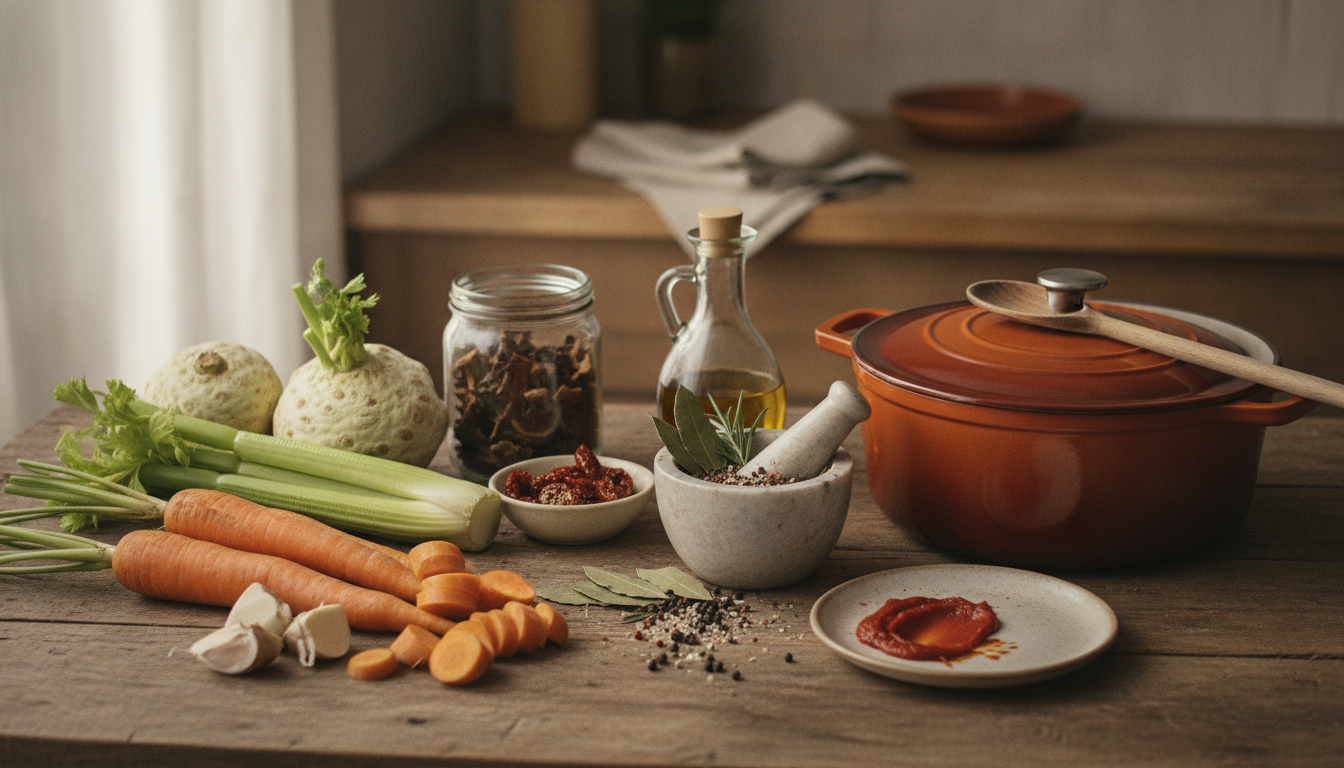
The foundation of a traditional ragù begins with a soffritto—a combination of diced onion, carrot, and celery cooked slowly in fat. When making a vegetable ragù, expanding this base to include dense, earthy root vegetables like parsnips, celeriac, or turnip, as well as fresh mushrooms, adds complexity and structural bite.
The method used to cut these vegetables determines the final texture of the sauce. Hand-dicing produces small cubes that maintain their individual boundaries, resulting in a soup-like finish. To mimic the uniform texture of finely minced meat, the vegetables should be broken down into fine, uniform particles.
A box grater using the medium-hole side or a food processor fitted with a multi-use blade pulsed in short bursts yields the ideal particle size. Grating or fine-pulsing ruptures plant cell walls, allowing internal moisture to escape rapidly once heat is applied. This accelerated release of water speeds up the cooking process.
Furthermore, smaller particle sizes drastically increase the surface area exposed to the pan. Greater surface area means more direct contact with hot fat and metal, accelerating the Maillard reaction—the chemical reaction between amino acids and reducing sugars that produces deep, complex, savory flavors. As the finely shredded root vegetables cook down, they soften into a dense, uniform matrix that naturally holds sauce together.
Concentrating Flavors and Pinçage
Once the water released by the vegetables has evaporated, browning begins. Cooked slowly over medium heat in generous amounts of olive oil, the root vegetables turn golden and fragrant. At this stage, introducing tomato paste provides both acidity and umami, but the paste must be treated properly to maximize its contribution.
Adding tomato paste directly along with wine, water, or broth dilutes its potential. Raw tomato paste contains sharp, raw acidity and unbound water. To transform it, cooks use a technique known in classical French culinary tradition as pinçage.
Clear a space in the center of the pan by pushing the browned soffritto to the perimeter. Add a splash of extra-virgin olive oil to the exposed metal, then drop the tomato paste directly into the warm oil. Cook the paste in the hot fat for two to three minutes, stirring constantly.
During this step, three things happen. First, residual moisture in the paste evaporates. Second, heat breaks down harsh citric acid into milder compounds. Third, the natural sugars in the tomato paste caramelize, and free glutamates concentrate. The color of the paste shifts from bright red to a deep, dark rust hue. Once this color change occurs, the caramelized paste is stirred back into the root vegetable base, coating every particle in a concentrated, savory shell.
Emulsification Through Pasta Starch
In the absence of gelatin, a vegetable ragù faces a physical challenge: oil and water do not mix. As the sauce simmers with wine, broth, or vegetable liquor, the oil used to brown the vegetables will tend to separate, floating to the surface and leaving a thin, watery liquid underneath.
The solution lies in the starch released by cooking pasta. Starch molecules act as a bridge between fat and water molecules, suspending fine oil droplets throughout the liquid to form a stable emulsion.
To leverage this reaction, cook the pasta in a reduced volume of salted water rather than an overly full pot. Less water concentrates the starch leached from the pasta during boiling, creating a cloudy, thick cooking liquid.
When the pasta is roughly one minute away from reaching al dente, transfer it directly into the saucepan containing the vegetable ragù. Add a generous splash of the hot, starchy pasta cooking water to the pan. Increase the heat to medium-high and toss or stir the contents vigorously.
The mechanical motion of tossing, combined with heat, forces the olive oil, tomato solids, dissolved vegetable starches, and concentrated pasta starch to bind together. The liquid transforms into a glossy coating that clings tightly to every ridge of the pasta. The result is a ragù with the rich mouthfeel of a long-simmered meat sauce, constructed entirely from root vegetables, oil, and starch.
Open Crave It!