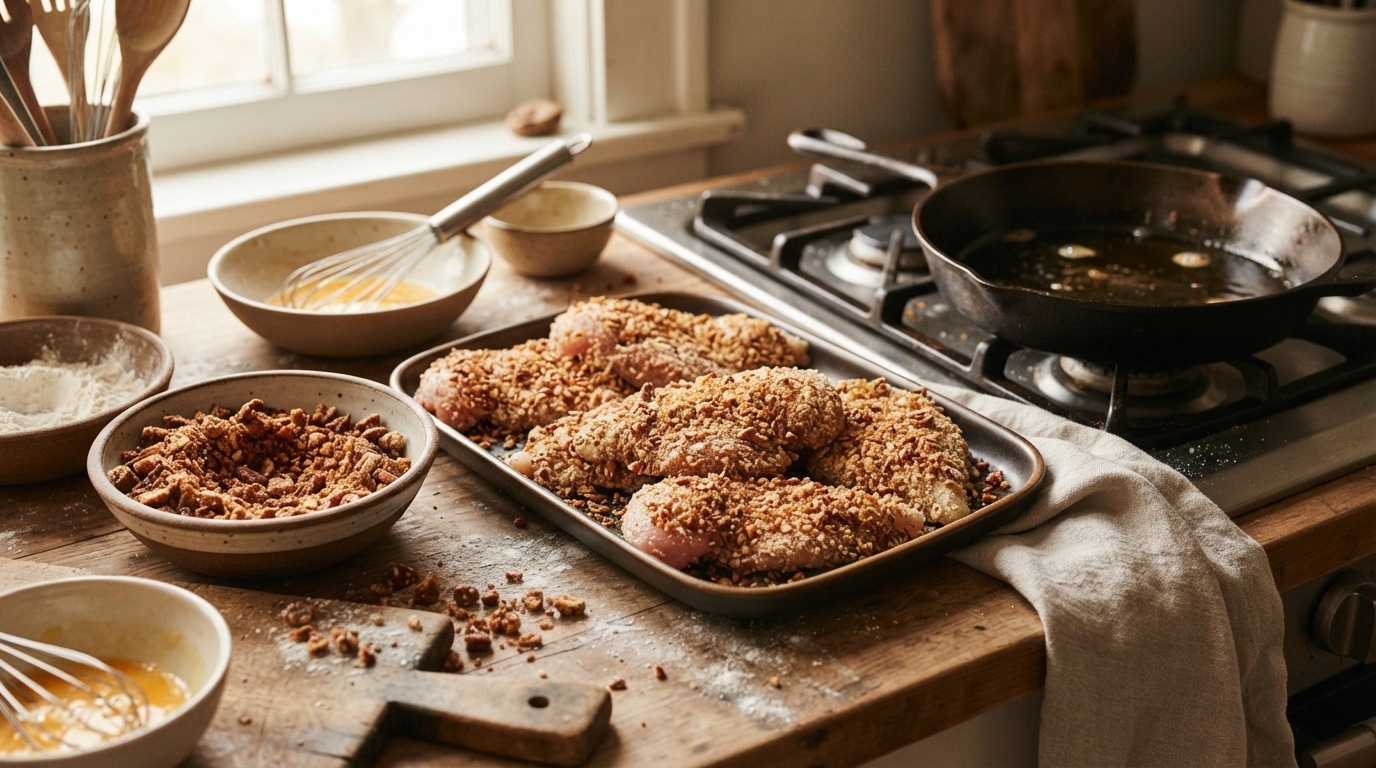
The Physics of the Pretzel Crust
Recipe IdeasStandard breadcrumbs have a structural flaw. Whether fine, coarse, or panko, dry breading relies on porous, open-grained starch structures that draw in moisture. When applied to meat, the moisture escaping from the cooking protein vaporizes, turning into trapped steam. That steam softens the interior face of the breadcrumb layer while the exterior attempts to crisp in hot oil. The result is a coating that degrades quickly, especially when paired with a pan sauce.
Hard pretzels solve this structural problem. A hard pretzel is not simply dried bread. It is a dense, low-hydration dough subjected to an alkaline bath before baking. That bath gelatinizes surface starches, producing a tight, glassy skin that browns deeply under oven heat. When pulverized into coarse crumbs, hard pretzels retain that low-water matrix. They do not absorb moisture readily. The crumbs remain rigid, salt-forward, and resistant to steam, making them an exceptional candidate for pan-fried cutlets.
The Mayonnaise Binder
The traditional breading setup relies on a three-step sequence: flour, beaten egg, and breadcrumbs. The flour dries the surface of the meat; the egg acts as a wet glue; the crumbs provide the exterior texture. While effective, this system introduces multiple failure points. If the flour layer is too thick, the coating slides off in a sheet. If the egg wash pools, it creates gummy pockets beneath the crust.
Substituting mayonnaise for the flour and egg wash eliminates these vulnerabilities. Mayonnaise is a stable emulsion of vegetable oil, egg yolk, and an acid such as vinegar or lemon juice. Because it is predominantly fat rather than water, it does not dissolve or soak into the protein surface the way an egg wash can.
A thin coating of mayonnaise spread directly over a trimmed pork chop acts as a uniform adhesive. The egg yolk proteins in the emulsion bind tightly to the meat, while the high fat content creates an insulator. When the chop hits the hot skillet, the oil within the mayonnaise helps fry the pretzel crumbs from the inside out, while the emulsion prevents trapped steam from loosening the crust. The bond remains intact from the skillet to the cutting board.
Frying Pretzel-Crusted Pork Chops
Cooking a pretzel-breaded chop requires a slight adjustment in pan temperature compared to standard breadcrumbs. Because hard pretzels have already undergone extensive browning during their original manufacture, their starches contain a high concentration of pyrazines and dextrins. These compounds brown rapidly when exposed to secondary cooking fat.
Pan-frying should take place over medium heat rather than medium-high. A neutral oil with a high smoke point provides the best medium, filled to a depth that reaches halfway up the thickness of the cutlet. Pork chops pounded to a uniform thickness of roughly half an inch allow the meat to cook through to a safe internal temperature at the exact moment the pretzel crumb turns a deep mahogany.
Because pretzels carry their own coarse salt from the bag, the meat requires minimal additional seasoning. The salt present on the crushed pretzel fragments dissolves slightly into the mayonnaise coating during cooking, seasoning the surface of the pork without drawing out excess juices before the chop hits the pan.
Building and Serving the Sauce
A crisp fried coating presents a dilemma when paired with a pan sauce. Pouring a warm liquid directly over a freshly fried cutlet saturates the crust, breaking down the crisp structure within minutes. Omitting the sauce entirely, however, leaves the dish dry.
The solution lies in sauce construction and mechanical placement. After the chops are fried and set aside to rest on a wire rack, the skillet retains browned bits of protein along with residual fat and toasted pretzel fragments. A simple pan sauce constructed from three pantry staples—coarse mustard, honey, and a splash of chicken stock—deglazes the pan and pulls those toasted flavors into an emulsion.
The mustard provides acidity and emulsifying mustard mucilage, the honey balances the sharp salt of the pretzel crust, and the stock lifts the fond from the bottom of the skillet. Whisked over medium heat for two minutes, the liquid reduces into a glossy, pourable sauce.
Plating determines whether the dish retains its crispness. Rather than spooning the pan sauce over the top of the chop, the sauce belongs on the plate first, forming a shallow base. Laying the pretzel-crusted chop directly onto the pool of sauce keeps the top and sides of the crust dry and exposed to the air. Each cut of the fork draws a portion of the crisp chop through the warm, sharp honey mustard beneath it, preserving the structural integrity of the pretzel crust down to the final bite.
Open Crave It!