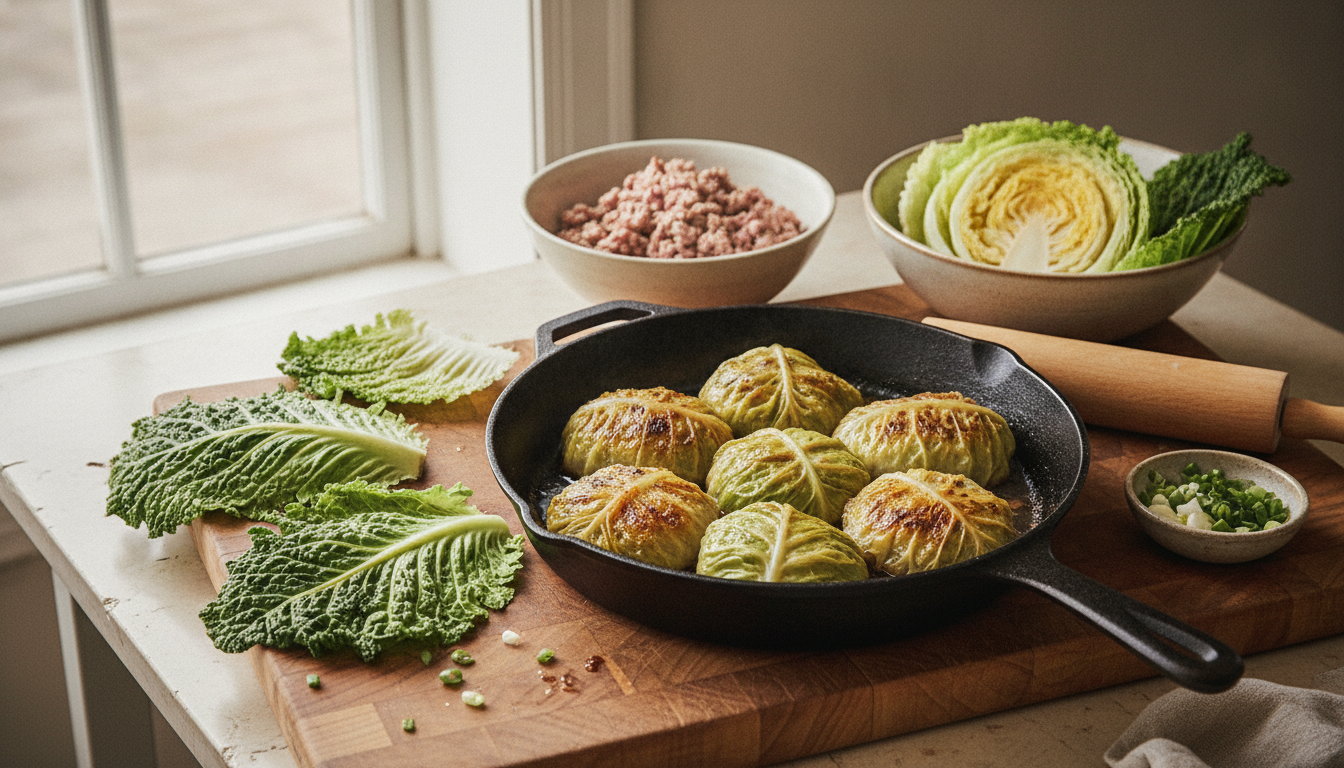
The Skillet Cabbage Dumpling
Recipe IdeasThe Logic of the Leaf Wrapper
A traditional dumpling wrapper relies on wheat flour and water. When cooked in a hot skillet with oil and liquid, the starch on the bottom browns into a crisp crust while the upper portion steams soft. Replacing dough with a cabbage leaf changes the mechanics of the wrapper, but the foundational cooking process remains the same. Savoy and Napa cabbage contain structural fibers and natural sugars that react quickly to heat. Using whole leaves as wrappers creates a package that is lighter, rich in protein, and straightforward to assemble without kneading or rolling dough.
While a wheat wrapper seals through sticky starches, a cabbage leaf relies on moisture control and physical folding. Cabbage does not absorb fat or liquid in the same way flour does. Consequently, the success of a leaf-wrapped dumpling depends on proper leaf preparation, balanced filling moisture, and precise temperature management in the pan.
Selecting and Preparing the Cabbage
Not all cabbages work equally well for wrapping. Standard green or red cabbages have dense, thick leaves that resist folding and take too long to soften. Savoy cabbage, with its crinkled, pliable texture, and Napa cabbage, with its broad, tender ribs, are ideal. Savoy leaves hold their shape well under heat and carry a gentle, earthy flavor. Napa cabbage offers a tender texture that cooks quickly and absorbs surrounding seasonings.
Raw cabbage leaves are rigid. Attempting to roll a raw leaf around meat will cause the structure to crack. Blanching softens the plant cell walls, making the leaves pliable enough to wrap tightly around a center filling. A brief plunge into salted boiling water—for roughly sixty to ninety seconds—is sufficient to yield the necessary flexibility without cooking the vegetable completely through.
Once blanched, the leaves must be transferred to cold water to halt the cooking process. Thoroughly drying the leaves afterwards is a critical step. Surface moisture prevents a tight wrap and causes hot oil to spatter during cooking. Lay the blanched leaves flat on towels and pat them dry. Finally, use a knife to shave down the thick central stem at the base of each leaf. Reducing the stem's thickness ensures the leaf folds smoothly without tearing.
Assembling the Filling and Wrap
Because cooked cabbage leaves are smooth and non-porous, the interior filling must hold itself together during cooking. Ground pork and ground chicken are reliable protein bases. Pork provides natural fat that keeps the center juicy, while chicken offers a leaner option that readily absorbs seasonings.
A classic filling combines the minced meat with aromatics such as ginger, garlic, green onions, soy sauce, and sesame oil. To keep the meat tender and bind excess moisture, a small amount of cornstarch or egg can be worked into the ground meat. The filling should be thoroughly mixed until it forms a cohesive, sticky paste.
To assemble, place a small portion of filling near the stem end of a dried, blanched leaf. Roll the stem end over the meat, tuck in the outer sides, and continue rolling toward the ruffled edge. Because cabbage leaves lack gluten or flour starches, they cannot be pinched shut like traditional dough wraps. Instead, the seam is held closed by resting the dumpling seam-side down, using the weight of the filling to maintain the shape until heat sets the leaf in place.
Sear and Steam in the Skillet
The appeal of a potsticker lies in the contrast between a tender, steamed top and a browned, crispy bottom. Replicating this dynamic with a cabbage leaf requires managing how the leaf caramelizes in hot oil. Instead of frying a flour starch, the bottom of a cabbage dumpling browns through the caramelization of its natural plant sugars.
Set a heavy skillet over medium heat with a light coating of neutral oil. Place the wrapped dumplings into the pan seam-side down. Contact with the hot surface sears the folded edges closed and prevents the roll from unravelling. Allow the dumplings to cook undisturbed for two to three minutes. The underside of the leaf will deepen in color and develop a golden crust.
Once the bottoms are seared, pour a small splash of water or stock into the skillet and immediately cover it with a tight lid. The trapped liquid turns to steam, cooking the meat filling through and softening the upper layers of the cabbage leaf. Let the pan steam over medium heat for five to six minutes.
Remove the lid for the final minute of cooking to allow remaining surface liquid to evaporate. As the pan dries out, the oil left behind re-crisps the bottom of the leaf. Transfer the dumplings to a plate and serve immediately with a dipping sauce of soy sauce and vinegar.
Open Crave It!