The Vine and the Vessel: A Brief History of Wine
A Brief History OfThe Clay Pot and the Wild Grape
Wine was not invented. It was discovered. The fruit of Vitis vinifera, the Eurasian grapevine, carries yeast naturally on its skin. When ripe grapes fall into a container and crush under their own weight, fermentation begins automatically. The sugar in the fruit turns into alcohol and carbon dioxide gas.
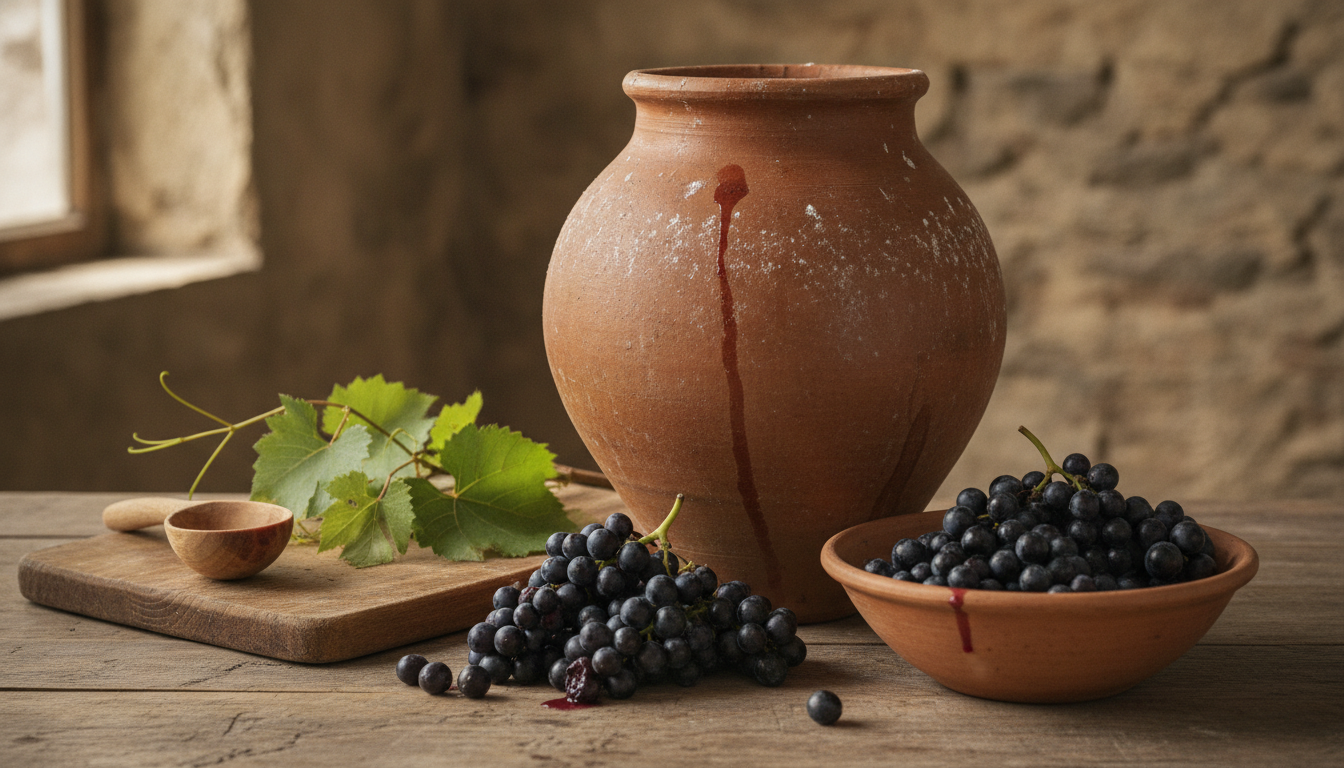
Archaeological evidence places the earliest intentional winemaking in the South Caucasus, in territory that is now modern Georgia. Clay vessels dating back to roughly 6000 BCE show chemical traces of tartaric acid, the primary marker of grape wine. These early winemakers buried large, pointed terracotta jars called qvevri in the ground to keep the fermenting juice cool. Similar evidence has been uncovered in the Zagros Mountains of Iran and across the Fertile Crescent.
These early drinks were different from modern wine. They were thick, unfiltered, and prone to rapid spoilage. To keep the liquid from souring into vinegar, ancient winemakers added resin, spices, honey, and tree gums. What started as an accidental process soon became an organized agricultural practice. Farmers selected vines with sweeter fruit and larger clusters, beginning the long domestication of the grape.
The Mediterranean Trade
As seafaring commerce expanded, so did wine. The Phoenicians were instrumental in spreading viticulture around the Mediterranean basin. From their ports in the eastern Mediterranean, they traded wine, vines, and pottery to North Africa, southern Spain, and the Italian peninsula.
The ancient Greeks elevated wine from simple sustenance to a cultural foundation. They planted vineyards across their colonies in southern Italy and Sicily, regions they called Oenotria, or the land of trained vines. Greek wine was almost always diluted with water before drinking. To drink unmixed wine was considered uncivilized. The Greeks stored their wine in ceramic amphorae sealed with pine resin and clay, trading it heavily across the Aegean and Black Seas.
The Romans expanded this model on an industrial scale. As the Roman Empire grew, its armies established vineyards across conquered lands to ensure a steady supply of wine for soldiers and citizens. Vines were planted along major river valleys in Gaul, the Iberian Peninsula, and along the Rhine and Moselle rivers. The Romans refined viticulture, classifying grape varieties and studying soil types. They also adopted the wooden barrel from Celtic tribes in Gaul, replacing heavy terracotta amphorae with a lighter, more durable container that also imparted flavor to the liquid inside.
The Monastic Vineyard
With the fall of the Western Roman Empire in the fifth century, trade networks collapsed. European vineyard culture was largely preserved by the Christian Church. Wine was necessary for the sacrament of the Eucharist, which gave religious institutions a practical reason to maintain grape vines.
During the Middle Ages, Catholic monasteries became the centers of agricultural research in Europe. Benedictine and Cistercian monks in France and Germany spent centuries tending vineyards, recording weather patterns, and observing how different plots of land produced different flavors. In Burgundy, Cistercians built stone walls around specific parcels of land, identifying subtle variations in soil drainage and sun exposure. This work laid the foundation for the concept of terroir—the idea that a wine reflects the specific environment where its grapes were grown.
Monastic estates established many of the famous wine regions known today, including those in the Loire Valley, the Rhine, and the hills of Champagne. The monks kept detailed records of vine pruning, harvesting times, and pressing methods, slowly refining the quality of European wine over hundreds of years.
Glass, Cork, and Science
For most of history, wine was consumed close to where it was made, usually within a year of harvest. Extended storage was difficult because exposure to air quickly turned wine into vinegar. Two technical developments in the seventeenth century changed this entirely: heavy glass bottles and bark cork stoppers.
Improvements in industrial furnaces, particularly in England, made it possible to manufacture thick glass bottles capable of holding liquid under pressure without breaking easily. At the same time, traders rediscovered the elasticity of cork, the outer bark of the cork oak tree native to the western Mediterranean. A cork hammered into a thick glass bottle created an airtight seal.
For the first time, wine could age for years or even decades. The liquid changed in the bottle, developing complex aromas and softening harsh tannins. Regions like Bordeaux, Port, and Tokaji built international reputations on wines that improved with age.
In the mid-nineteenth century, the French scientist Louis Pasteur solved the biological mystery of fermentation. Before Pasteur, fermentation was thought to be a purely chemical breakdown. Pasteur demonstrated that living yeast cells consumed sugar to produce alcohol and carbon dioxide, while bacteria caused wine to turn to vinegar. Understanding the role of microbes allowed winemakers to control sanitation, temperature, and sulfur usage, making clean, reliable wine possible on a commercial scale.
Rebuilding the Roots
In the late nineteenth century, the global wine industry faced near-total destruction. American vine species brought to Europe by plant collectors carried a microscopic aphid named Phylloxera vastatrix. Native American vines had evolved resistance to the insect, but European Vitis vinifera vines had no defense. The pest attacked the root systems, killing millions of acres of vineyards across Europe within a few decades.
The solution was simple in concept but massive in execution: European grape varieties were grafted onto North American rootstocks. The rootstock provided immunity to the aphid, while the grafted top portion produced traditional European grape varieties. Almost all of the world's commercial wine vines today are grafted in this manner.
At the same time, European settlers brought vines to California, South Africa, Australia, New Zealand, and South America. These regions adapted ancient European varieties to different climates and soils, developing their own winemaking traditions and styles.
Today, winemaking combines ancient agricultural principles with precise microbiology and environmental control. Yet the fundamental process remains unchanged from the clay jars of the South Caucasus: juice pressed from grapes, acted upon by yeast, transforming fruit into wine.
Open Crave It!