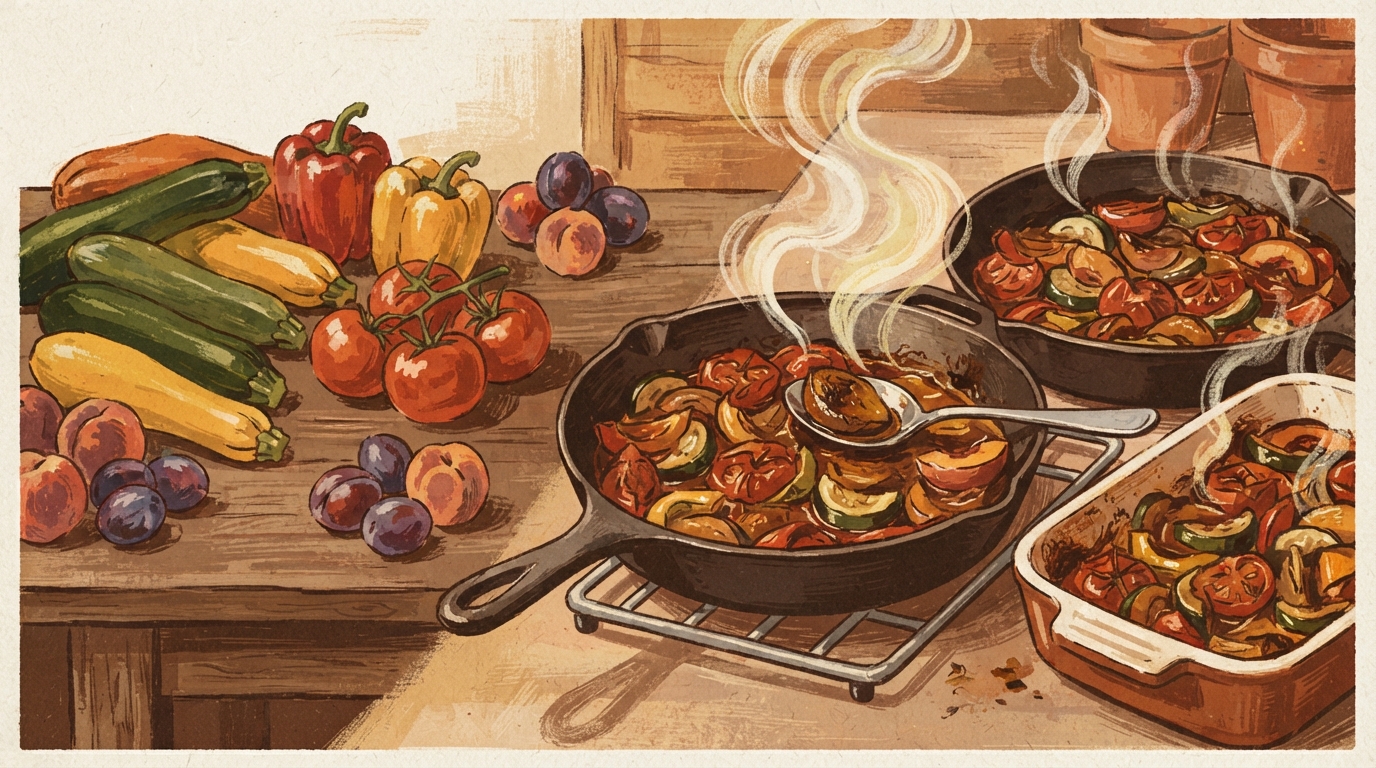
Transforming Late-Summer Produce for Autumn Cooking
SeasonalThe Problem of Water
Late summer brings an abundance of zucchini, tomatoes, peppers, and stone fruit. These crops are built for hot weather. They consist mostly of water—often well over ninety percent in the case of zucchini and tomatoes. In August, their crispness and light, watery freshness are desirable. By October, when cravings shift toward dense braises, stews, and baked dishes, that same moisture becomes an obstacle.
Water dilutes flavor. It also prevents food from reaching temperatures high enough to trigger caramelization and the Maillard reaction. These chemical processes are responsible for the deep, complex, savory notes that define cool-weather cooking. To make summer produce work in heavier meals, the primary task is moisture management. You must remove excess water before or during cooking to concentrate natural sugars, acids, and aromatic compounds.
High Heat and Charring
Before a vegetable can join a slow-simmered pot, driving off initial surface moisture creates essential depth. Roasting at high temperatures or charring directly over a flame alters the chemical structure of high-moisture fruits and vegetables.
Tomatoes and bell peppers contain natural sugars that caramelize when exposed to dry heat above three hundred degrees Fahrenheit. Charring skin under a broiler or over an open flame scorches the exterior, introducing smoky, slightly bitter notes that balance sweetness. This step changes how the ingredient behaves in a dish. A raw tomato simmered in autumn yields a thin, acidic broth. A roasted, charred tomato cooked down with garlic and oil yields a heavy, jammy sauce with sufficient body to coat pasta or braised meat.
Peaches and nectarines undergo a similar change. While typically eaten raw or lightly cooked in summer desserts, high-heat roasting drives out water and intensifies both acidity and sugar. A roasted late-season peach develops a concentrated, cooked-fruit character that stands up to heavy winter preparations, such as braised pork, roasted poultry, or whole grain dishes like farro and barley.
Reduction in the Braising Pot
Long, slow reduction is the second method for converting high-moisture produce into autumn food. Where roasting uses ambient dry heat to strip surface water, braising uses liquid heat over extended time to break down tissue and evaporate excess liquid.
Zucchini and eggplant are structural sponges. When sliced into a quick stir-fry, their cellular walls hold water, keeping them light and firm. When cooked slowly in an open pan or dutch oven, those cellular walls collapse. As steam escapes, the plant fibers soften into a rich, unified puree or stew.
This technique requires leaving the pan uncovered for at least part of the cooking time. A covered pot traps steam, condensing it back into the liquid and keeping the flavor dilute. An uncovered pot lets steam escape, concentrating dissolved solids, natural glutamates, and sugars. Cooking zucchini, tomatoes, and peppers down for two to three hours converts a watery mixture into a dense, spoonable base.
This concentrated base can be served directly or used as a foundation for winter soups and bean stews. A spoonful of deeply reduced zucchini-and-tomato base adds body and savory depth to dark stock or lentils without requiring butter, cream, or flour.
Adapting Summer Squash to Winter Bakes
Winter squashes, such as butternut and acorn, are low in water and high in starch. Summer squashes, such as zucchini and yellow crookneck, are the opposite. Substituting summer squash into recipes designed for pumpkin or butternut squash requires adjusting for this structural difference.
If added directly to a baked dish like a gratin, pie, or heavy quick bread, raw summer squash releases its water during baking. This results in a soggy interior, broken emulsions, or gummy batter. Swapping summer squash into autumn bakes requires three adjustments.
First, extract water before assembly. Grate or thinly slice the summer squash, toss it with a small amount of salt, and let it sit in a colander. Salt draws water out through osmosis. After resting, squeeze the squash thoroughly in a clean kitchen towel. A pound of raw zucchini can lose up to half its weight in water through salting and pressing.
Second, dry-roast the pre-drained squash. Spread the squeezed squash on a sheet pan and roast it at high heat until dry and lightly browned. This step cooks off remaining surface moisture and develops the roasted flavor expected in cool-weather dishes.
Third, compensate for starch. Winter squash provides structure through starch. Summer squash does not. If you are replacing pureed butternut squash with pureed summer squash in a savory loaf or custard, increase the binding agents slightly. Adding an extra egg yolk or a small amount of flour or cornstarch compensates for the missing starch and prevents the finished bake from collapsing.
Open Crave It!